Thursday, January 29, 2015

Make in US, sell in India deal for renewable energy


As the euphoria around US President Barack Obama's visit ebbs, the fine print of the investment announcements reveal a financial boost for American solar energy companies to increase their exports to India.


Of the investments announced by the US federal agencies in the clean energy space, most are institutional loan for US solar companies, aimed at increasing their export to the growing renewable energy (RE) market India, especially solar power. The $1-billion loan agreement that the US Exim banksigned with Indian Renewable Energy Development Agency (Ireda), would be extended to US solar cell manufacturing companies that will export to India, said Indian government officials.


"The push has been given to US solar companies already selling or planning to sell in India to expand their presence through either exports or manufacturing," said a senior official.


Currently, only Sun Edison and First Solar are the two major American companies with operations in India.


The cost of solar cells globally has been on a decline owing to over-capacity in the developed markets and demand from Asian countries including India. US solar cell prices have come down to $0.6 a watt in 2014 from $0.75 a watt a year before. Even the Chinese module price has come down sharply to $0.5 per watt. For those expecting a concessional rate of interest from the US, there isn't any.

A loan offered by the US Exim, along with Ireda, would fall in the same bracket of 10-12 per cent as offered by other domestic lending institutions.


"US Exim offers a loan at four per cent but the hedging cost is as high as eight per cent. Ireda would charge an additional two per cent. It's at par with Indian agencies funding to RE projects. Unlike German state bank KfW or Asian Development Bank and World Bank, the US agencies do not fund projects. In short, this is an impetus to US solar business in India," said a senior executive tracking the US-India energy deals. While the country aims to add around 4,500 Mw of solar power capacity during the current financial year, the manufacturing capacity is only 1,500 Mw. The central government has recently revised targets for solar and wind energy capacity addition. While solar power capacity addition has been revised to 1,00,000 Mw and wind power generation target is 60,000 Mw, both by 2022.

Mahindra to expand renewables business amid India's clean energy push

(Reuters) - Indian conglomerate Mahindra Group plans to expand its renewable energy business and invest 45 billion rupees ($732.5 million) over the next three to four years, its chairman said, amid a government-led push to increase the use of clean energy.
The investment will mainly be financed by taking on 33 billion rupees in debt, with the rest funded through cash, Chairman and Managing Director Anand Mahindra told Reuters.
Anand Mahindra, chairman and managing director of Mahindra & Mahindra, attends the India Economic Summit 2014 at the World Economic Forum in New Delhi November 5, 2014. REUTERS/Anindito Mukherjee/Files
Anand Mahindra, chairman and managing director of Mahindra & Mahindra, attends the India Economic Summit 2014 at the World Economic Forum in New Delhi November 5, 2014.
The group also plans to commission 500 megawatts (MW) of solar power projects by the end of March 2016 from 180 MW it expects to complete by end-March this year, he added.
"The (renewable energy) business is going to boom this year. It is a very attractive investment right now," Mahindra said on Sunday.
The renewable energy unit, which builds solar power projects and offers off-grid power solutions, was formed in 2011 and is currently one of the smaller businesses of the $17 billion autos-to-technology conglomerate.
Prime Minister Narendra Modi has ramped up his target for solar energy by 33 times to 100,000 megawatts (MW) by 2022 as he bets on renewables to help meet rising power demand and overcome the frequent outages that plague Asia's third largest economy.
Modi says India needs $200 billion - half of it from foreign companies - to meet its target and U.S. President Barack Obama pledged on Sunday during a visit to India to support this ambitious goal through additional funding.

New-generation solar panels far cheaper, more efficient - scientists

LONDON (Thomson Reuters Foundation) - A new generation of solar panels made from a mineral called perovskite has the potential to convert solar energy into household electricity more cheaply than ever before, according to a study from Briain's Exeter University.
Super-thin, custom-coloured panels attached to a building's windows may become a "holy grail" for India and African countries, Senthilarasu Sundaram, one of the authors of the study, told the Thomson Reuters Foundation.
"In those countries these types of material will be like a holy grail: they can both shade windows ... and at the same time produce electricity," he said.
With a thickness measured in billionths of a metre, solar panels made of perovskite will be more than 40 percent cheaper and 50 percent more efficient than those commercially produced today, Sundaram said.
Unlike other solar panels, those made of perovskite can absorb most of the solar spectrum and work in various atmospheric conditions, rather than only in direct sunlight.
"This type of material for solar cells works in diffused conditions much, much better than the other types of solar cells," said Sundaram. "It won't be 100 percent, but it will be much more than what we have now."
Researchers have already tested the material in the Americas, Asia, Europe and the Middle East.
Current commercial products used to generate solar power, such as silicon or thin-film based technologies, are expensive because they are processed using vacuum-based techniques, the Exeter study said.
The production process for perovskite panels is very straightforward, but researchers still have to test the material under different conditions to better understand its properties, before companies embark on industrial-scale production, it said.

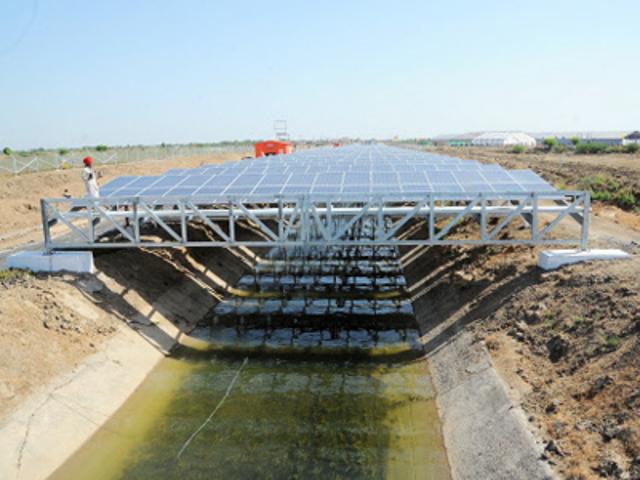
India builds solar plants atop canals to save land, water

VADODARA (Thomson Reuters Foundation) - As India moves to ramp up investment in solar power, it is exploring innovative places to install solar plants, including across the top of canals.
Last weekend, U.N. Secretary General Ban Ki-moon inaugurated a new "canal-top" solar energy plant in Vadodara district in India's western state of Gujarat.
"I saw more than glittering panels – I saw the future of India and the future of our world," said Ban. "I saw India's bright creativity, ingenuity and cutting-edge technology."
Experts identify two major advantages in building solar plants atop canals: efficient and cheap land use, and reduced water evaporation from the channels underneath.
Earlier this month, India showed it is serious about expanding energy production from renewable sources. Prime Minister Narendra Modi upped the country's investment target for solar alone to $100 billion, saying India would scale up solar power to over 10 percent of its total energy mix by 2022.  
As part of that effort, the Ministry of New and Renewable Energy plans to create 100 megawatts (MW) of capacity from grid-connected solar photovoltaic (PV) power plants built on top of canals and on their banks by the end of the government's latest Five Year Plan in 2017.
The ministry will subsidise 30 percent of estimated expenditure of $154 million to construct facilities to meet the canal-top goal.
The 10 MW plant on the outskirts of Vadodara city, which began generating power in November, is built across 3.6 km of irrigation canal, and has 33,800 solar panels mounted on steel scaffolding.

There's a sunny future ahead for rooftop solar power: here's why

Over the past five years the world has seen a dramatic fall in the cost of solar energy, particularly rooftop solar panels or solar photovoltaic power. It is now a real alternative and considerable player in the power markets.
In Australia more than 4 gigawatts (peak generation capacity) of solar panels are mounted on more than a million Australian roofs to date, adding up to about 7% of Australia’s electricity generation capacity.
As solar panels do not always produce all the electricity they possibly can, rooftop solar today contributes around 2% of Australia’s total electricity generation. But in some states during the day, solar’s contribution already reaches double digits. You can watch solar generation live here.
But what’s next for rooftop solar? It’s likely that costs will continue to fall, eventually making solar the dominant source of electricity in many parts of the world including Australia. Here’s the evidence.
Falling costs
The following 2014 graph from investment bank Bernstein Research shows just how fast the cost of solar has fallen compared to other energy sources.
Bernstein Research comparing the cost for a million British thermal unit (mmbtu) of various liquid fossil fuels and solar EIA, CIA, World Bank, Author provided
The graph plots the price for one million British thermal units of various fossil fuels and solar power. It shows that the price for solar energy came down dramatically in comparison to fossil fuels and has just started to undercut the price for some of these such as petroleum and liquefied natural gas (LNG).
Currently, solar panels in Australia produce energy at a cost of A10c per kilowatt hour or less, and it is likely that by 2020 this will fall to A6-7c per kilowatt hour or less. This puts solar power into a very competitive spot within the next five years.

Germany to launch first auction of land for solar power

FRANKFURT Jan 28 (Reuters) - Germany is to open a first auction of land for solar power installations from next month as it seeks to bring renewable energy into the wholesale power market, away from a costly era of subsidies.
The cabinet on Wednesday agreed rules for a pilot project to auction open spaces for the deployment of 1.2 gigawatts (GW) of installed photovoltaic capacity over the next three years.
"We are creating the basis for a competitive promotion of renewable energies," Economy Minister Sigmar Gabriel said in a statement.
The number is small given that total solar capacity already totals well over 35 GW but if the move is successful, from 2017 onwards, other renewables such as wind power could be brought into similar schemes.
The system agreed on Wednesday entails the energy regulator, the Bundesnetzagentur, collecting offers up to April 15 to award permits to build 500 MW of solar in 2015, 400 MW in 2016 and 300 MW in 2017.
The bidders with the lowest possible price proposals for the power to be produced on the land will win. The power would have to marketed at that price, which would replace the current system of 20-year guaranteed state hand-outs.
As free land is scarce, the government also plans to provide some 1,000 hectares of federal land in 2016 and 2017 for the purpose and also include some land that has been defined as unsuitable for farming.
The government is partly acting under the watchful eye of Brussels which last year stepped up pressure on Berlin over the generous subsidies that have turned Germany into a champion of wind and solar, but cost taxpayers dearly and undermined trading in the wholesale market for thermal power.
The government in a law last August pledged that renewable operators will be increasingly asked to face commercial risks, such as dealing with trading and infrastructure costs, supply shortages and lack of storage for electricity.
It curbed direct incentives and set caps on the expansion of green power.

The BSW solar industry lobby said the latest move was "bureaucratic and its success uncertain". The capacity to be auctioned was too small, given that an annual expansion of solar power of 7.5 GW is allowed. (Reporting by Vera Eckert and Markus Wacket; Editing by Michael Urquhart)

Solar power stocks rally upto 11% on Indo-US partnership on clean energy

NEW DELHI: Companies with exposure to the solar powersegment rallied up to 11 per cent in tarde on Tuesday, after US President Barack Obama and Prime Minister Narendra Modi pledged to collaborate in the area of clean energy and combat climate change.
A team of senior US officials and executives from funding agencies, ministries and companies will interact with Indian officials from the finance ministry, Reserve Bank of India and other agencies to help India meet its ambitious target of adding 1 lakh megawatt of clean energy, which is 40% of the country's total generation capacity now, at a cost of Rs 6 lakh crore, said an ET report.
Officials said Power, Coal & Renewable Energy Minister Piyush Goyal is determined to ensure that new renewable capacity is built with innovative and sustainable funding, not subsidies and handouts.
Already, the Adani Group and New York-listed SunEdison have announced plans to invest $4 billion to set up India's biggest solar equipment plant, added the report.
The solar energy sector has so far imported huge amounts of low-cost Chinese equipment, drawing criticism from local manufacturers.
"There will be more such investments in India. The government is determined to attract companies and make it easier for them to do business in the country. India already allows 100% FDI in renewable energy, and encourages technology transfer," ET reported quoting a government official.
India offers several incentives for clean energy. Distribution companies are mandated to source a part of their electricity from clean sources under the system of 'renewable purchase obligation'.
Source: India Times